Construction Estimating Software for Contractors
Price the job and level every sub quote against the same scope before you bid. When you win, the budget and buyout are built on the leveled numbers, and Shackleton drafts each subcontract from the quote you choose.
Trusted by companies building the future













Construction Estimating Software From Pricing to Buyout
Construction estimating software prices a job before you bid it. In Shackleton, the estimate is the first stage of the job record, so the numbers you bid with carry into the bid budget, the buyout, and the project without being retyped. Shackleton isn’t takeoff software. Your quantities come from the takeoff tool you already use.
Pricing the Job
Price materials, labor, and equipment against the quantities from your takeoff tool, line by line, before the sub quotes are added in.
Sub Quotes by Package
Subcontractors quote each package through a shared portal link, so every bid comes back against the same scope.
Leveling on Equal Scope
Mark each scope item Included, Excluded, Allowance, or By Others, and put your own number on each exclusion before totals are compared.
Bid Budget to Buyout
The bid budget and proposal are built from the leveled numbers. Awarded numbers carry into buyout, the chosen quote becomes a draft subcontract, and a won bid becomes a project with its RFIs and team.
Bid packages and the subcontractor portal are part of Shackleton’s bid and proposal control, so your construction project estimating software and your bid process share one record. On a won job, the budget is tracked by cost code in Finance & Budget, alongside change orders and invoices.
How AI Construction Estimating Software Levels Sub Quotes
AI construction estimating software reads each sub quote against your scope sheet before you compare totals. In Shackleton, a custom agent marks every line Included, Excluded, Allowance, or By Others and drafts the scope clarification for you to send. The estimator decides what each exclusion is worth and who gets the work.
Shackleton’s own example levels six bids for the same job.
| Bid | Initial Bid | Revised Bid |
|---|---|---|
| Bid 1 | $547,863 | — |
| Bid 2 | $559,289 | — |
| Bid 3 | $502,361 | — |
| Bid 4 | $646,463 | $561,431 |
| Bid 5 | $580,899 | — |
| Bid 6, awarded | $608,881 | $533,927 |
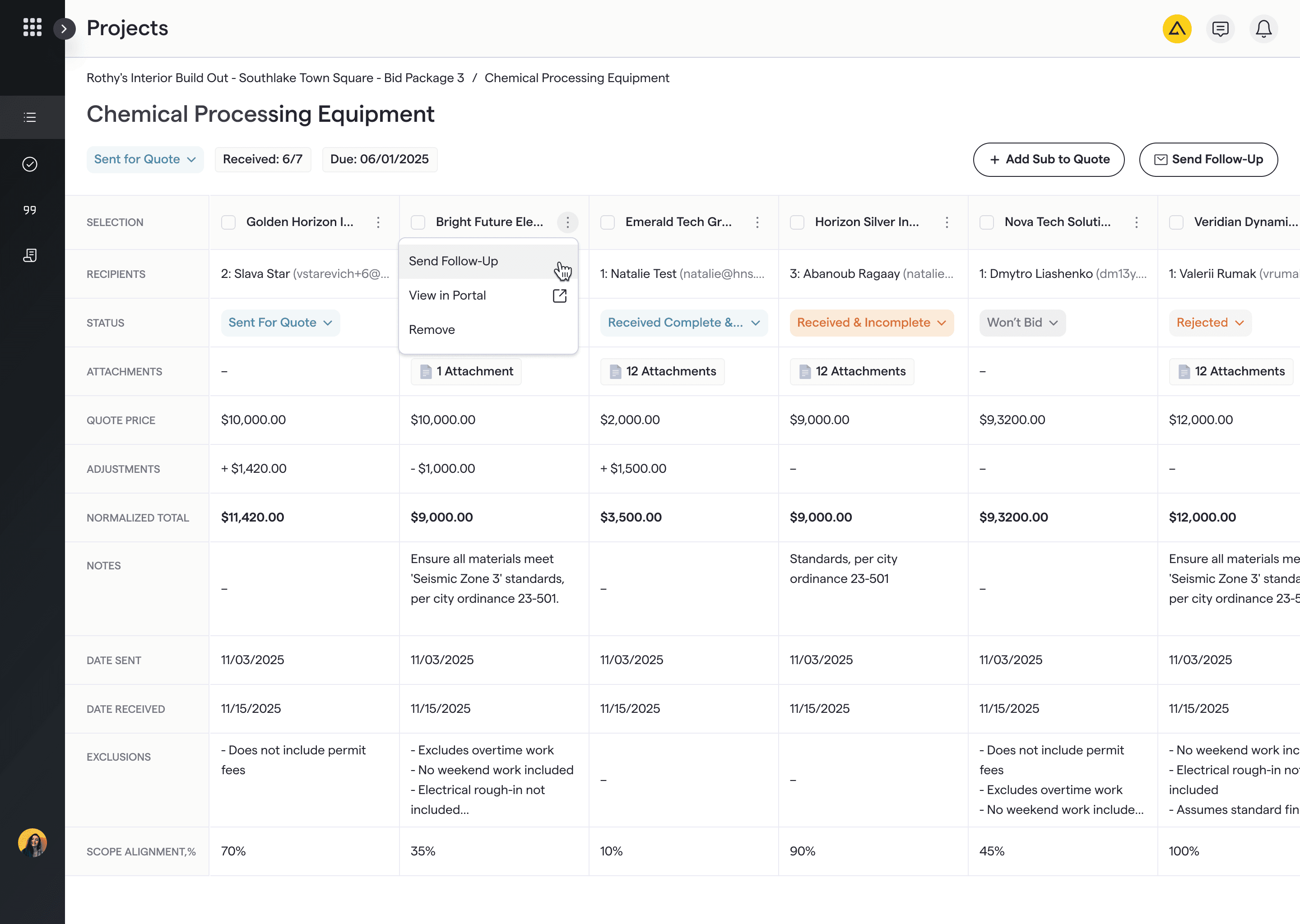
Leveling showed where each bid was off, so the calls with the bidders covered specific line items. Two bidders revised, and the awarded bid came down $74,954.
Bids and Budgets That Came In Lower
Shackleton powers construction teams across 15+ states, managing over $1 billion in project value. On one multi-unit buildout, leveling the bids in Shackleton brought the buyout in 15% lower than the initial bid. A multi-brand franchise operator’s three Austin buildouts finished 12.5% under their estimated budget.
buyout than the initial bid, after leveling the bids
Multi-unit buildout
the estimated budget across three Austin buildouts
Multi-brand franchise operator
Original data
On the multi-unit buildout, every bid was priced against one bid form and loaded into the project. A custom agent compared the bids side by side and showed where each one was off. The team took those line items into its calls with the bidders, and the revised bid became the buyout.
Methodology: the 15% compares the customer’s initial bid with its final buyout, as reported to Shackleton in 2026. The franchise operator’s result is published in its case study on Shackleton’s case studies page.
I had it give me a comparison of three different GCs, showing where they were different in their bid. The key takeaway showed where one was higher than the other two, and I could speak directly to those line items.
Operations Executive
Multi-Unit Buildout
Shackleton gave us complete visibility across all three buildouts simultaneously. We went from scrambling between spreadsheets and phone calls to having every detail — budget, schedule, daily reports — in one place. That’s how we finished 35% faster and meaningfully improved our IRR.
Matt G.
Ops Manager, Multi-Brand Franchise Operator
See What Leveling Shows on Your Bids
Bring three bids, and our team will level them with you.
About Shackleton
Shackleton is the agentic platform for construction. Mid-sized general contractors and subcontractors use it from the first estimate through closeout, and owners and developers use it to follow every site in a program. Costs sync to QuickBooks, Sage, and other accounting systems, and custom agents handle the data entry between estimating, field, and accounting work while your team makes the decisions.
Learn How Shackleton Works
See how an estimate moves into the budget and the buyout.
What Is Construction Estimating Software?
Construction estimating software, also called construction estimation software, is a program for working out what a construction job will cost before it is bid. An estimate built in a construction estimating tool usually adds up nine parts.
- Quantities from the takeoff
- Unit costs for materials and equipment
- Labor hours and rates
- Sub quotes by trade package
- General conditions
- Overhead and profit
- Allowances for scope not yet decided
- Alternates priced apart from the base bid
- Contingency
Most construction estimating programs end at the priced estimate, saved apart from the rest of the job. With stand-alone construction estimate software, the awarded numbers are exported to a spreadsheet or retyped into accounting after the job is won. Death by a Thousand Systems, on the Shackleton blog, adds up what that retyping costs a builder in wasted salary, errors, and extra hires.
Construction Estimate Types by Project Stage
An estimate changes shape as a project moves from concept to contract, and good construction estimator software carries it through each stage.
| Stage | When It’s Prepared | Built From | What It Decides |
|---|---|---|---|
| Order of magnitude | Concept, before design | Program size, historical cost per unit | Whether the project is feasible |
| Schematic | Early design | Rough quantities, assembly pricing | The budget range design proceeds against |
| Design development | Mid design | Refined quantities, early sub input | Scope trade-offs before drawings are final |
| Construction documents | Hard bid or GMP, before award | Full takeoff, leveled sub quotes | The contract price and the bid budget |
The construction documents estimate is the one Shackleton carries into the bid budget after award. Each job you price is tracked from first contact to signed contract in Shackleton’s pipeline and proposal management.
Checks Before a Sub Quote Goes Into Your Construction Estimate
Whatever contractor estimate software you price with, a sub quote belongs in the estimate only after four checks. Each one catches a gap that would otherwise come back as a change order.
Scope by Division
The quote matches your scope sheet division by division, and every clarification is in writing.
Exclusions and By-Others Items
Each exclusion carries your own number, and each by-others item is assigned to a trade.
Allowances and Alternates
Allowances are carried at a real number, and alternates sit apart from the base bid.
Validity and Insurance
The quote’s validity date is still current and the sub’s insurance hasn’t lapsed. A custom agent flags any sub invoice submitted after the sub’s insurance lapses.
What Retyping Bid Numbers Costs You
Check off the estimating and accounting tools your team moves numbers between, and the free Software Cost Calculator works out what retyping costs you each year.
Frequently Asked Questions
What Is the Difference Between Takeoff and Estimating?
Takeoff measures the quantities on the drawings, and estimating prices them. Building estimating software usually handles both, adding unit costs, labor, sub quotes, and markup to the measured quantities. Shackleton covers the estimating side and leaves takeoff to the tool you measure with.
Can AI Do Construction Estimating?
AI can do parts of it, such as reading sub quotes against a scope sheet and flagging what each one leaves out. In Shackleton, AI construction estimating stops at the flag and the drafted clarification, and the estimator sets the price.
What Is Bid Leveling?
Bid leveling adjusts every sub quote for a package to the same scope before prices are compared. It keeps a quote that leaves work out from looking cheaper than it is.
How Does an Estimate Become the Project Budget?
After award, the construction documents estimate becomes the budget the job is tracked against, line by line. In Shackleton, the awarded numbers move into buyout and the job’s cost codes without being entered again.
Is There Construction Estimating Software for Small Contractors?
Yes. If you only need a price, a simple tool sold as construction estimating software for small business will do. If you level sub quotes and want the awarded numbers to carry into buyout and the budget without retyping, Shackleton fits regardless of company size.
Can Subcontractors Use Construction Estimating Software?
Yes. Subcontractors use it to price their own scope before they quote a general contractor, and Shackleton serves mid-sized subcontractors as well as GCs.
Is Shackleton Web-Based Estimating Software?
Yes. Shackleton is web based construction estimating software, so estimators open the estimate and the sub quotes in a browser. As online construction estimating software, it keeps precon and project teams on the same record after award.
Bring Your Next Bid Into Shackleton
Start with a job you’re pricing now and see the numbers carry into the budget.